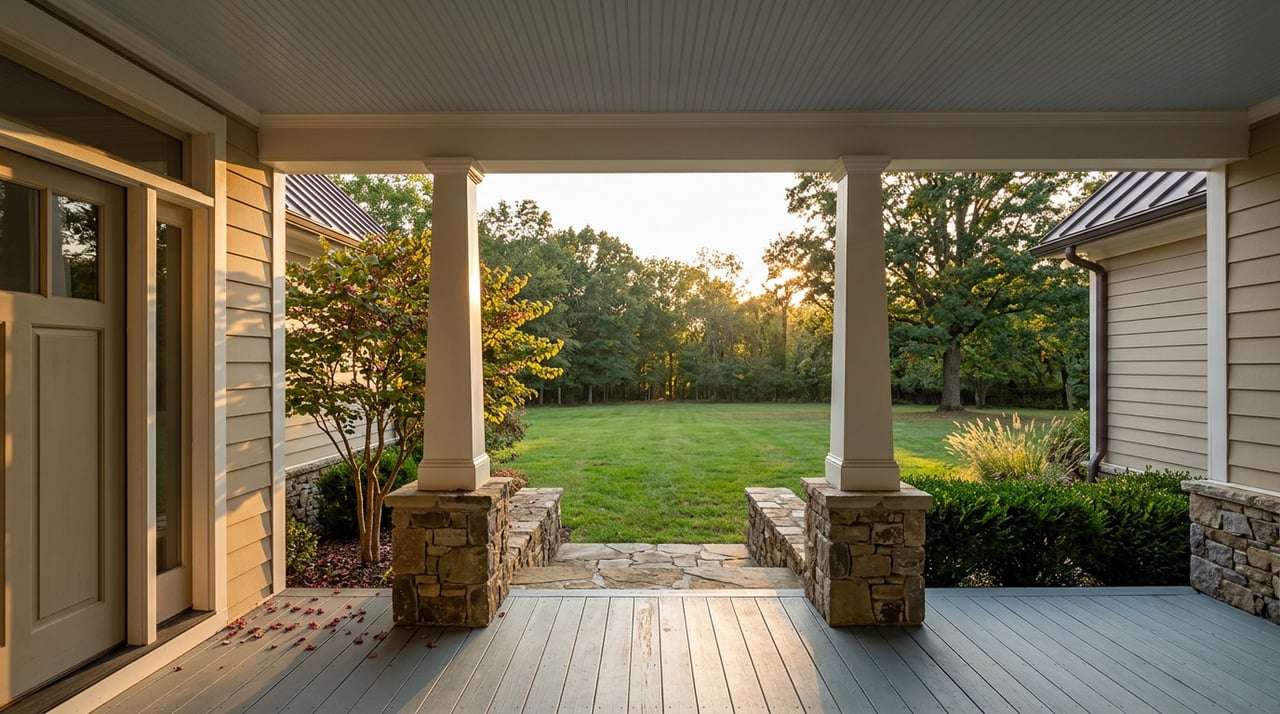
Lexington's Growth Line Just Got Its First Rulebook in 68 Years, and It Explains What Your Money Actually Buys
September 24, 2026
September 24, 2026
Drive east on Winchester Road out of Lexington and at some point, with no sign to mark it, the subdivisions stop and the fields start. Nothing about the soil changes. What changes is access to a water line and a sewer line, and that access was decided by a rule older than most of the houses you just passed.
That rule is called the Urban Service Boundary, and Lexington drew it in 1958, the first city in the country to do so. For 68 years it has quietly done more to shape what a Lexington home costs than square footage, school zones, or curb appeal ever could. And this year, for the first time in its entire history, that line got a formal rulebook for how and when it changes. If you're comparing Lexington's price tag to what the same budget buys in Winchester, Owingsville, Mount Sterling, or anywhere else in the surrounding counties, this is the mechanism worth understanding before the comparison, not after.
The Urban Service Boundary controls something specific: which land in Fayette County is allowed to receive city water and sewer, and which land is left to function as agricultural, rural, or conservation land instead. Cross the line, and you're in a subdivision. Stay outside it, and you're on a well and a septic system, likely on a much larger lot, because that's what the absence of municipal infrastructure requires.
For decades the boundary barely moved. It was expanded once, in 1996, by about 8 square miles across three areas, including what's now the Hamburg area. Then it sat unchanged for nearly 30 years while Fayette County's population kept growing inside the same fixed footprint.
| When | What Happened |
|---|---|
| 1958 | Lexington adopts the Urban Service Boundary, the first city in the country to draw one |
| 1996 | The boundary expands by about 8 square miles, including the Hamburg area, and then holds for almost three decades |
| June 2023 | The Urban County Council votes 13-2 to add roughly 5,000 acres, including land near I-75 and Winchester Road, the Lexington Sporting Club stadium site, and the Parkers Mill and Man o' War area |
| November 2024 | The Planning Commission adopts the Urban Growth Master Plan, which governs how that new expansion land can actually be built out |
| February 2026 | Council adopts the Lexington Preservation and Growth Management Program, the first standing, repeatable process the boundary has ever had for deciding when it changes again |
That last line is the one worth sitting with. For 68 years, whether the boundary moved came down to whichever council happened to be in office at the time, working through the comprehensive planning process case by case. Starting this year, the city has a written process that's supposed to repeat on a five-year cycle, using population and job growth data to decide if and where the line should move next.
Fayette County covers roughly 285 square miles. Only about 85 of those square miles, close to 30 percent, sit inside the Urban Service Boundary. The rest, nearly 200 square miles, is designated agricultural, rural, or conserved land where new subdivisions generally can't go. Yet close to 97 percent of the county's population lives inside that smaller 30 percent.
That ratio is the actual price mechanism at work. It isn't that Lexington's inside-the-line neighborhoods have something surrounding counties lack. It's that almost the entire county's demand for housing is legally confined to less than a third of its land, while the other 70 percent sits largely off limits to new development by design. Councilmember James Brown, describing why the city finally wanted a formal process rather than another one-off vote, put it plainly after the February 2026 adoption: the city wanted "a process and a data-driven plan in place" for growth decisions going forward.
That scarcity shows up clearly in the sale prices. Across all of Lexington, the median sale price sat at $350,000 for the three months ending in May 2026, according to Redfin. Narrow that to Downtown Lexington specifically, and the median jumps to $945,000 over the same window, up nearly 12 percent year over year. Same county, same boundary, wildly different numbers, because "inside the line" isn't one market. It's dozens of smaller ones stacked on top of each other, all competing for the same fixed 30 percent of land.
Land outside the Urban Service Boundary, and land in a different county altogether, isn't rationed by the same rule. It was never inside the scarcity line to begin with.
That distinction matters differently depending on where you're standing:
Across my own recent transactions, sale prices have ranged from $22,000 to $565,000, averaging around $221,000, spanning everything from small starter homes to acreage and manufactured housing. That spread only makes sense once you understand it's happening in a market that was never bounded the way Fayette County's is. A buyer priced out of the $350,000 Lexington median, let alone the $945,000 downtown figure, isn't necessarily settling for less by looking toward Winchester or Owingsville. They're looking at land that plays by a different set of rules entirely.
One detail from the 2023 expansion is worth flagging specifically if you're watching both the Lexington and Winchester markets: part of that roughly 5,000-acre addition sat along the I-75 and Winchester Road corridor, the same road that carries traffic east toward Clark County and the city of Winchester itself. That doesn't mean Winchester was annexed into Lexington's boundary. It means growth pressure inside Fayette County is being deliberately funneled toward the corridor that already connects the two markets, which is exactly the kind of detail that shows up years later as increased traffic, new commercial development, and shifting demand along that stretch. If you're comparing what's coming for Winchester against what's happening in Lexington, that corridor is the one to watch first.
It's tempting to assume more land inside the boundary automatically means lower prices. The research doesn't fully back that up. A 2017 University of Kentucky study, cited repeatedly by local land-use groups during the 2023 expansion debate, found that Lexington's land-use policy wasn't pushing home prices up faster than comparable cities, and that expanding the boundary might lower prices only slightly, and likely only temporarily. Growth advocates and preservation advocates have used that same study to argue opposite conclusions, which tells you how unsettled the actual price effect is. What isn't unsettled is that adding acreage inside the line doesn't instantly translate into cheaper housing citywide. It changes where new supply can go. It doesn't change the underlying math of 97 percent of a county's population competing for 30 percent of its land.
If you're weighing Lexington's median price against a home in Bath, Montgomery, or Clark County, you're not comparing two versions of the same market. You're comparing a market where supply is legally rationed against markets where it isn't. That's worth knowing before a headline number decides where you start your search, and it's worth remembering the next time the boundary comes up for another five-year review under its new process.
Does the Urban Service Boundary affect property tax rates? No. It controls access to city water and sewer service, not the tax rate itself. Tax rates are set separately by the relevant taxing authorities.
Is another expansion coming soon? There's no expansion currently scheduled. The new Lexington Preservation and Growth Management Program sets up a repeatable review process, expected to draw on population and job data roughly every five years, but it doesn't guarantee when or if more acreage gets added next.
Does any of this affect Winchester, Mount Sterling, or Owingsville directly? Not directly. Those communities sit in separate counties with their own water and sewer systems, entirely outside Fayette County's boundary. What does reach them is the ripple effect: as Lexington's inside-the-line inventory tightens, more buyers start looking at what those surrounding markets actually offer.
If you're trying to figure out what your specific budget actually buys once you start comparing Lexington to the smaller markets around it, Zachary Otis has spent his career working exactly that line, on both sides of it. Let's connect and talk through what makes sense for where you're starting and where you're trying to land.
Stay up to date on the latest real estate trends.


From Salt Lick, Kentucky, he is very passionate about serving others and being a positive voice in his community. He hopes to assist his clients by negating the stress that buying or selling real estate may cause.